
In short. Icepick, boxcar, rolling, hypertrophic and keloid scars each respond to different treatments; scars are improved rather than erased, and acne is controlled first.
Key points
- Subcision, sometimes with a filler, releases the fibrous bands responsible for rolling scars.
- Fractional laser and microneedling remodel the surface and improve boxcar and rolling scars.
- Focal chemical reconstruction is used for icepick scars.
Acne scarring is structural: the skin has lost or gained tissue, and no treatment restores the original surface completely. The realistic goal is measurable improvement, usually described in percentages rather than absolutes, achieved over a series of sessions with the acne fully controlled first.
Know which scar you are treating
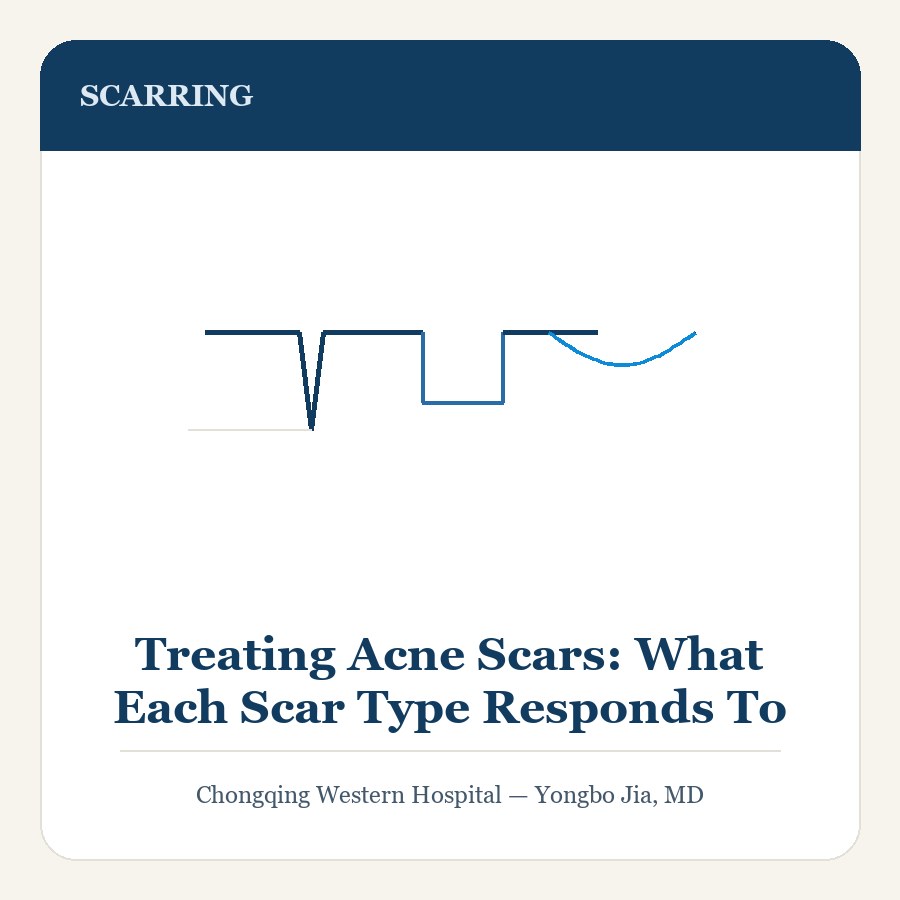
Atrophic scars are depressions, and they come in three common shapes. Icepick scars are narrow and deep, like a puncture. Boxcar scars have sharp vertical edges and a flat base, and they vary in depth. Rolling scars have soft, sloping edges and give the skin a wavy appearance, caused by fibrous bands tethering the skin downward. Hypertrophic and keloid scars are the opposite problem: raised, firm tissue, more likely on the jawline, chest and back, and more common in darker skin tones. Most people have more than one type, and each responds to a different approach.
Control the acne first
This is not a formality. Treating scars while new inflamed lesions are still forming means working against a moving target, and new lesions create new scars. Isotretinoin is sometimes part of that control, and modern practice allows scar procedures to be planned without the long waiting period that was once recommended, decided case by case.
Matching treatment to scar type
Subcision, sometimes with a filler, releases the fibrous bands responsible for rolling scars. Fractional laser and microneedling remodel the surface and improve boxcar and rolling scars. Focal chemical reconstruction is used for icepick scars. Punch techniques remove or elevate individual deep boxcar and icepick scars surgically. Raised scars are treated with intralesional injection, silicone, pressure and sometimes laser. Most plans combine two or three of these.
What treatment feels like over time
Improvement is incremental and cumulative. A typical plan involves several sessions spaced weeks to months apart, with assessment between them, and the skin continues to remodel for months after the last session. Some redness, swelling and a short recovery period follow most procedures. Pigment change is the main risk to discuss, particularly in darker skin tones, where treatment can itself leave marks, which is why settings and intervals are chosen conservatively rather than aggressively.
What to be sceptical of
Be cautious with any offer of complete scar removal, with packages sold before the scars have been examined, and with the promise of a single session. Creams and oils marketed for scar removal do not rebuild lost collagen, though they may help with colour and moisture. The honest position is that good treatment makes scars substantially less noticeable, and no treatment makes them disappear.
Seek assessment if
- Acne is still active and scarring — control and scar planning should be decided together.
- A scar is raised, growing beyond its original boundary, painful or itchy — keloid behaviour needs early treatment.
- A scar is being treated without a diagnosis of scar type or a discussion of pigment risk in your skin tone.
Frequently asked questions
Why does the scar type decide the treatment?
Icepick scars are narrow and deep like a puncture, boxcar scars have sharp vertical edges and a flat base, rolling scars have soft sloping edges caused by fibrous bands tethering the skin down, and keloid scars are raised. Each responds to a different approach.
What results should I realistically expect from scar treatment?
Measurable improvement, usually described in percentages rather than absolutes, over a series of sessions spaced weeks to months apart. Improvement is incremental and cumulative, the skin continues to remodel for months after the last session, and no treatment makes scars disappear.
What is the main risk of scar treatment in darker skin?
Pigment change. Treatment can itself leave marks in darker skin tones, which is why settings and intervals are chosen conservatively rather than aggressively. A scar that is raised, growing beyond its original boundary, painful or itchy needs early treatment rather than observation.
Risks & Limitations
- Most chronic skin disease is managed rather than cured, and relapse is expected.
- Treatments typically need 8–12 weeks before response can be judged fairly.
- Topical treatment can cause irritation, dryness, peeling and photosensitivity.
- Systemic therapy may require blood monitoring and carries organ, metabolic and pregnancy risks.
- Isotretinoin in particular requires strict monitoring and pregnancy prevention.
- Pigment change is often slow and may be incomplete.
- No treatment works for everyone, and response cannot be predicted with certainty.
When to Seek Care
- A mole or lesion that changes in size, shape or colour, or starts to bleed, itch or crust.
- Fever with a widespread rash, blistering, or rash involving the eyes, mouth or genitals — seek emergency care.
- Rapidly spreading redness, swelling or pain in the skin.
- Facial swelling or difficulty breathing — possible severe reaction; seek emergency care immediately.
- New or worsening symptoms while taking a monitored medication.
References & Further Reading
- American Academy of Dermatology (AAD) — public and clinical guidance
- World Health Organization (WHO) — skin and infectious disease resources
- Chinese Medical Association, Dermatology Branch — clinical guidance
- Cochrane Library — systematic reviews in dermatology
This page is patient education, not medical advice, and it does not cite individual studies. Discuss your own case with a qualified clinician. To arrange an assessment at Chongqing West District Hospital, see Contact & Consultation.